
Café Las Violetas, the confitería of stained glass
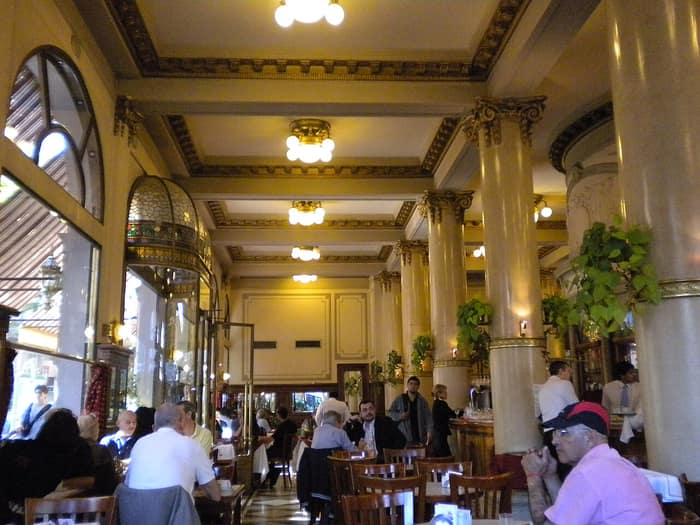
Café Las Violetas (Confitería Las Violetas) is a traditional bar, restaurant and tea room on the corner of Avenida Rivadavia and Avenida Medrano in the Almagro district of Buenos Aires. It opened in 1884 and keeps its stained glass, marble floors and period façade: one of the nicest stops if you are looking for hidden gems in Buenos Aires off the tourist trail.
It is often said that its stained glass came from France, but only the materials crossed the ocean: the design and assembly were done in a Buenos Aires workshop, from watercolour and ink sketches.
The history of Café Las Violetas
Las Violetas opened on 21 September 1884, founded by Messrs Felman and Rodríguez Acal. Its name is said to come from the flower beds of violets that decorated its front. It was always a luxury confitería, in contrast with the pulpería (rural-style general store and tavern) on the diagonally opposite corner. In its early days people arrived by train at Almagro station, one block away, or by a horse-drawn tram running along Rivadavia.
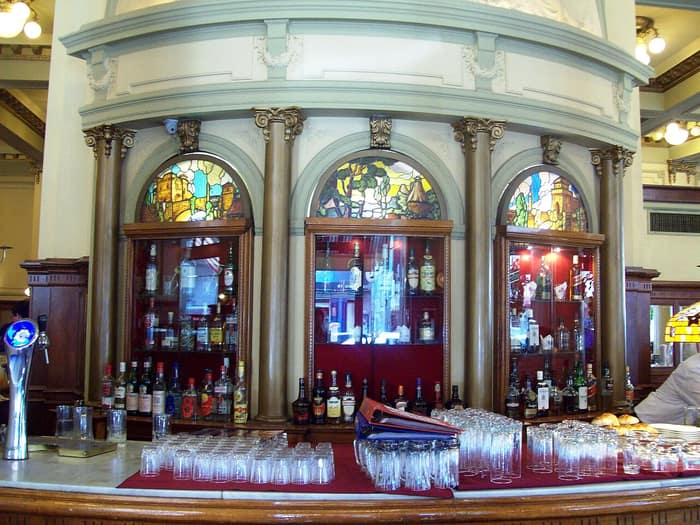
In the 1920s the premises were remodelled and gained shop windows, curved-glass doors, stained glass and Italian marble floors. The stained glass is often credited to France, but in fact only the materials came from there: the design and assembly were done in a Buenos Aires workshop, from preserved watercolour and ink sketches, and installed in 1928. It was made by Antonio Estruch, who had already worked on the Café Tortoni. In 1933 the property was auctioned and passed to Mateo Figallo and his family.
Many well-known people sat at its tables. During the Centenary celebrations it was visited by the Infanta of Borbón, who had arrived in the country on 18 May 1910. Roberto Arlt describes it in his short story Noche terrible, and regular singers included Carlos Gardel, who came with his friend Irineo Leguisamo, as well as José María Contursi and Azucena Maizani. A neighbourhood resident who became president, Arturo Frondizi, also dropped in. According to the sources, the Grandmothers of Plaza de Mayo used to meet there in those years, pretending to celebrate birthdays, to look for ways to recover their grandchildren abducted during the last dictatorship (1976-1983).
In the 1990s the owners declared bankruptcy and the café stayed closed between 1997 and 2001. In 1998 the city legislature declared it a Site of Cultural Interest. Between January and June 2001 a group of hospitality professionals restored it: the wood panelling, chandeliers, columns and ceiling were recovered, and as the floor was beyond saving another was built respecting the original size, shape and colours. The façade was kept whole, with its original marble. It reopened on 17 July 2001 and, two days later, to the general public.
Curious facts about Café Las Violetas
- Although the stained glass is often said to be from France, only the materials came from there: the design and assembly were done in a workshop on Calle Piedras in Buenos Aires.
- The name is said to come from the flower beds of violets that decorated its front.
- The watercolour and ink sketches for the stained glass have survived to this day.
- Carlos Gardel was a regular, and so was Arturo Frondizi, a neighbourhood resident who became president of Argentina.
- In its early days people arrived by train at Almagro station, a block away, or by horse tram along Avenida Rivadavia.
- During the 2001 restoration the floor, beyond saving, was rebuilt with the same size, shape and colours as the original.
Filmed at Café Las Violetas
Its period rooms have served as a set for Argentine cinema. According to Wikipedia, these films were shot there.
- Sol de otoño (1996) – This film also used Las Violetas as a setting.
Tours near Café Las Violetas
Experiences in the area that you can book online with Viator:


Visiting Café Las Violetas
- It works as a bar, restaurant and confitería; check the current opening hours before you go.
- It is worth looking at the 1928 stained glass, the floors, the chandeliers, the wood panelling and the original marble façade.
- It stands at the corner of Rivadavia and Medrano in Almagro, and Almagro railway station is one block away.
- It belongs to the city's group of notable bars, officially supported by city government programmes.
- After the 2001 restoration, accessible toilets were added.
Opening hours, access and conditions can change. Check before you go.
Map: where Café Las Violetas is
Photos of Café Las Violetas


Questions
What is Café Las Violetas?
It is a traditional bar, restaurant and confitería in Buenos Aires, opened on 21 September 1884. It belongs to the city's group of notable bars.
Where is Café Las Violetas?
On the corner of Avenida Rivadavia and Avenida Medrano, in the Almagro district of Buenos Aires.
Why is it called Las Violetas?
The name is said to come from the flower beds of violets that decorated its front.
Is the stained glass of Las Violetas French?
It is often said to be, but only the materials come from France. The design and assembly were done in a Buenos Aires workshop, and the glass was installed in 1928.
Which films were shot at Las Violetas?
According to Wikipedia, it served as a setting for La Mafia (1972) and Sol de otoño (1996).
When was Las Violetas restored?
After some years closed, it was restored between January and June 2001 and reopened on 17 July that year. The façade was kept whole.
Also nearby

Confitería del Molino
Balvanera, Buenos Aires · an Art Nouveau café with windmill sails
2.5 km away

Al Ahmad Mosque
San Cristóbal, Buenos Aires · minaret and onion dome
2.5 km away

El Ateneo Grand Splendid
Recoleta, Buenos Aires · a bookshop in a 1919 theatre
3 km away
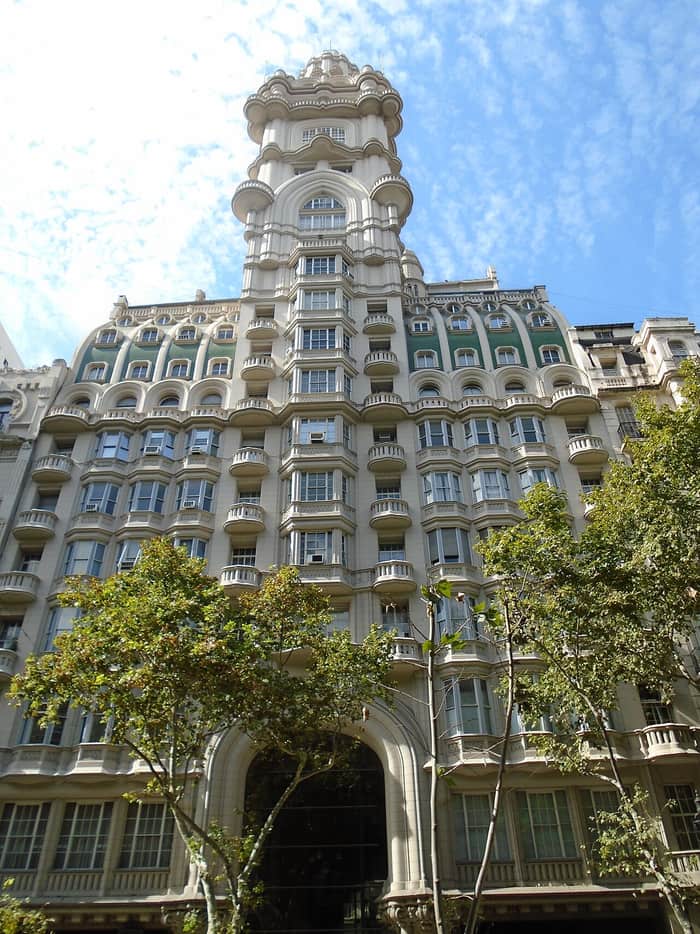
Barolo Palace
Avenida de Mayo, Buenos Aires · 22 floors that follow the Divine Comedy
3 km away