
San Ignacio Miní, Jesuit ruins in the Misiones forest
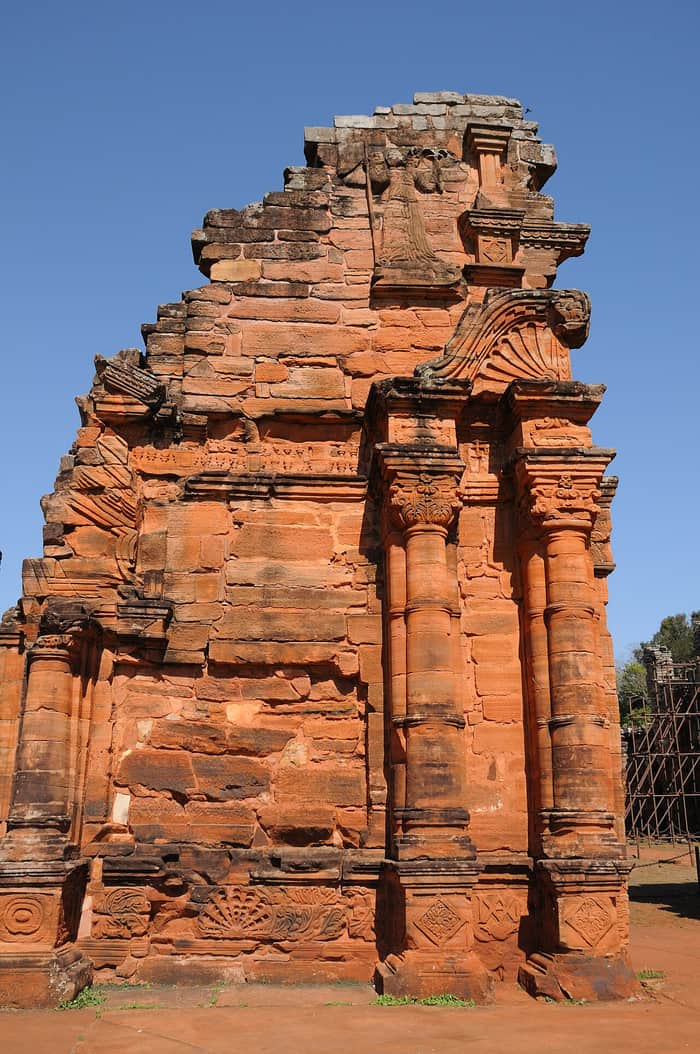
San Ignacio Miní is a 17th-century Jesuit reducción (mission settlement) in the town of San Ignacio, Misiones province, some 60 kilometres north of Posadas. Its red sandstone walls and Guaraní Baroque church make it one of the most rewarding stops among the hidden gems of north-east Argentina.
The forest covered these ruins until they were found again in 1897. Today they are among the best-preserved Jesuit missions in South America, with red stone walls still standing after two centuries.
The history of San Ignacio Miní
The original mission was founded around 1610 in the region the natives called Guayrá and the Spaniards La Pinería, in what is now the Brazilian state of Paraná, under the Jesuits José Cataldino and Simón Maceta. The purpose of the reducciones was to evangelise the Guaraní and organise them into towns. Attacks by the bandeirantes of São Paulo, who destroyed most of the reducciones, forced it to move west in 1632.
Hostilities forced it back east again, and after several sites that were later abandoned, it settled permanently on its present site in 1696. It was named San Ignacio Miní, miní meaning minor in Guaraní, to distinguish it from San Ignacio Guazú, the greater one, in Paraguay. In the 18th century the mission had between roughly 3,000 and 4,000 inhabitants according to the sources, mostly Guaraní, who made notable handicrafts that were traded along the nearby Paraná River.
The layout is the usual one in Jesuit missions: around a central square stood the church, the Fathers' house, the cemetery, the dwellings and the cabildo (town council building). The church, about 74 metres long by 24 wide, was designed by the Italian priest Juan Brasanelli and built with local red sandstone in large blocks, its walls some two metres thick. Its reliefs and details belong to the so-called Guaraní Baroque, and the decoration was carried out by Guaraní craftsmen.
With the expulsion of the Jesuits from the Americas in 1767, the reducciones began to decline; the religious community left the mission soon afterwards. In 1817 San Ignacio was destroyed in the wars of the period, although the sources differ on who attacked it. Abandoned, it was swallowed by the forest.
The ruins were found again in 1897 and gained public interest after the poet Leopoldo Lugones's expedition in 1903. Formal exploration and restoration began in the 1940s. In 1984 UNESCO inscribed the Argentine missions of San Ignacio Miní, Santa Ana, Nuestra Señora de Loreto and Santa María la Mayor as World Heritage, joining the Brazilian mission of São Miguel. Listed in 1996 in the first World Monuments Watch, the site has since received restoration work and an interpretation centre.
Curious facts about San Ignacio Miní
- Its name means minor in Guaraní, to tell it apart from San Ignacio Guazú, the greater one, in Paraguay.
- The mission moved several times: it began in what is now Brazilian Paraná around 1610 and only reached its present site in 1696.
- The church is about 74 metres long by 24 wide, and its red sandstone walls are around two metres thick, which has let them stand for more than two centuries.
- The ruins lay under vegetation until found again in 1897; the poet Leopoldo Lugones's expedition in 1903 made them famous.
- It is one of the best-preserved Jesuit missions in the region and, thanks to its easy access, one of the most visited.
- A community of Guaraní descendants lives in the town, where visitors can see handicrafts and plantations of yerba mate and stevia (káa-hée, the sweet herb).
Tours near San Ignacio Miní
Experiences in the area that you can book online with Viator:


Visiting San Ignacio Miní
- The ruins are in the town of San Ignacio, Misiones province, about 60 kilometres north of Posadas; check the current opening days and hours before you go.
- You can walk the layout of the mission: the great church, the central square, the indigenous residential area and the workshop buildings.
- The complex houses the Museo Jesuítico de San Ignacio Miní, and there is an interpretation centre with information on the history and culture of the missions.
- It is possible to get to know the town's Guaraní community, its handicrafts and its yerba mate and stevia plantations.
- The other missions in the province inscribed as World Heritage are Santa Ana, Nuestra Señora de Loreto and Santa María la Mayor.
Opening hours, access and conditions can change. Check before you go.
Map: where San Ignacio Miní is
Photos of San Ignacio Miní




Questions
What is San Ignacio Miní?
It is a Jesuit reducción founded in the early 17th century to evangelise the Guaraní and settled on its present site since 1696. Today it is a set of red sandstone ruins, a UNESCO World Heritage Site since 1984.
Where is San Ignacio Miní?
In the town of San Ignacio, Misiones province, about 60 kilometres north of Posadas.
What does Miní mean?
Miní means minor in Guaraní. It was named this way to distinguish it from San Ignacio Guazú, the greater one, in Paraguay.
What can you see at San Ignacio Miní?
The great church, about 74 metres long, the central square, the Fathers' house, the dwellings and the cemetery. There is also a museum and an interpretation centre.
When were the ruins of San Ignacio Miní rediscovered?
They were found again in 1897, covered by the forest, and became famous after Leopoldo Lugones's expedition in 1903. Formal restoration began in the 1940s.
What other Jesuit missions are there in Misiones?
Santa Ana, Nuestra Señora de Loreto and Santa María la Mayor, inscribed as World Heritage in 1984 together with San Ignacio Miní.
Also nearby

Martín García Island
Río de la Plata · an Argentine island surrounded by Uruguayan waters
813 km away

Zárate-Brazo Largo Bridge
Zárate and Brazo Largo · two cable-stayed bridges over the Paraná
830 km away

River Plate Fresh Meat Company
Campana, Buenos Aires · South America's first refrigeration plant
835 km away

Sarmiento House
Tigre, Buenos Aires · Sarmiento's wooden house in the Delta
844 km away