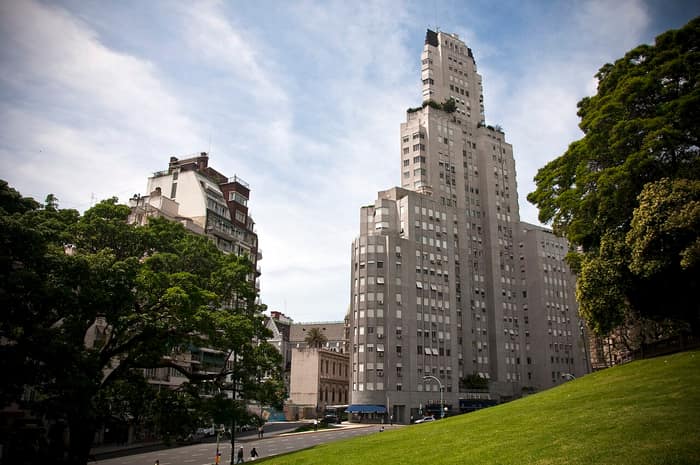
Kavanagh Building, the tower that topped Latin America
The Kavanagh Building is a 120-metre residential tower at 1065 Calle Florida, facing Plaza San Martín in the Retiro district of Buenos Aires. Inaugurated in 1936, it was the tallest building in Latin America for over a decade and is still one of the city's icons: an ideal stop if you are looking for what to see in Retiro.
Legend says a millionaire had this tower built to block a noble family's view of their church after they rejected her daughter's engagement. The sources say it is probably untrue, but the story lives on.
The history of the Kavanagh Building
The Kavanagh Building was the idea of Corina Kavanagh, a wealthy landowner of Irish descent who financed the tower and gave it her name. According to the English, Italian and Portuguese sources she sold two ranches to erect her own skyscraper facing Plaza San Martín, in the Retiro district.
It was designed in 1934 by the firm Sánchez, Lagos y de la Torre, made up of the architects Gregorio Sánchez, Ernesto Lagos and Luis María de la Torre, and built by the engineer Rodolfo Cervini. The reinforced-concrete structure was awarded to the Empresa Argentina de Cemento Armado (E.A.C.A.) on the basis of a preliminary design by the structural engineer Carlos Laucher; the final structural design was produced by the company's technical office under the engineer Fernando Schwarz. Works began on 16 April 1934 and the structure reached its full height on 3 November of the same year. The sources speak of only fourteen months of construction.
While it was still being built, in 1934, the upper part of the façade carried a white cross several storeys high, in honour of the International Eucharistic Congress held in Buenos Aires that year. The tower was inaugurated on 3 January 1936: at 120 metres it was the tallest building in Latin America until 1947, when it was surpassed by the Altino Arantes Building in São Paulo, and one of the tallest reinforced-concrete structures of its day.
Its stepped volume, with symmetrical setbacks that answered the city's planning rules, created garden terraces on the upper floors. The austere lines, lack of external ornament and large prismatic volumes make it a synthesis of rationalism and Art Deco, considered the high point of early Modernism in Argentina. Because of its orientation, its prow recalls a ship ready to sail towards the River Plate.
Since the apartments were aimed at the upper middle class, no expense was spared: all 105 apartments had central air conditioning supplied by the American firm Carrier, twelve Otis lifts and state-of-the-art plumbing. It was the first residential building in Buenos Aires with centralised air conditioning. Corina Kavanagh lived for many years on the 14th floor, the largest apartment, which fills an entire storey. Recognition came early: in 1936 it won the Municipal Award for Collective Houses and Facades and three years later its façade received an award from the American Institute of Architects. In 1994 the American Society of Civil Engineers named it a Historic Civil Engineering Landmark, and in 1999 the Argentine government declared it a National Historic Monument.
Curious facts about the Kavanagh Building
- A legend says the tower was raised as revenge: Corina Kavanagh's daughter supposedly fell in love with a son of the Anchorena family, who disapproved, so the building would block the Anchorenas' view of the Basilica of the Blessed Sacrament from their palace. The Portuguese and German sources note that the tale does not hold up, for instance because the woman who funded the church died in 1920.
- It has no garages and no entry-phone: every visitor must be announced at reception, which phones the apartment concerned.
- In a 2013 Clarín survey of 600 people who are not architects, it was voted the most beautiful building in Buenos Aires.
- In 1934, while construction was still under way, a white cross several storeys high was fixed to the upper façade for the International Eucharistic Congress.
- A passage named after Corina Kavanagh separates it from the Hotel Plaza.
- Its garden terraces offer views of the river, the parks and the city.
Tours near Kavanagh Building
Experiences in the area that you can book online with Viator:


How to see the Kavanagh Building
- It is a residential building and the sources mention no interior visits: the best way to enjoy it is from Plaza San Martín and Calle Florida.
- Look at how the tower steps back and how its prismatic volumes shrink towards the top, with no external ornament.
- The Paz Palace, the San Martín Palace and the Estrugamou Building, other distinctive buildings of Retiro, are very close.
- Around the square you can compare the rationalist architecture of the Kavanagh with the French-style palaces of the area.
Opening hours, access and conditions can change. Check before you go.
Map: where Kavanagh Building is
Photos of Kavanagh Building


Questions
What is the Kavanagh Building in Buenos Aires?
A 120-metre residential tower inaugurated in 1936 in the Retiro district, regarded as an example of rationalism and Art Deco. It was the tallest building in Latin America until 1947.
Where is the Kavanagh Building?
At 1065 Calle Florida, facing Plaza San Martín, in Retiro.
Who built the Kavanagh Building?
It was commissioned by Corina Kavanagh, designed by the firm Sánchez, Lagos y de la Torre and built by the engineer Rodolfo Cervini, with a structure by the company E.A.C.A.
Can you visit the inside of the Kavanagh Building?
It is an apartment building with 105 flats and visitors must be announced at reception; the sources mention no tourist visits, so it is mainly admired from the street.
Is the legend of Corina Kavanagh's revenge true?
The sources present it as a legend and several disprove it with dates: the woman who funded the basilica died in 1920, fourteen years before work began.
What honours has the Kavanagh Building received?
A Municipal Award in 1936, a façade award from the American Institute of Architects in 1939, Historic Civil Engineering Landmark status in 1994 and National Historic Monument status in 1999.
Also nearby
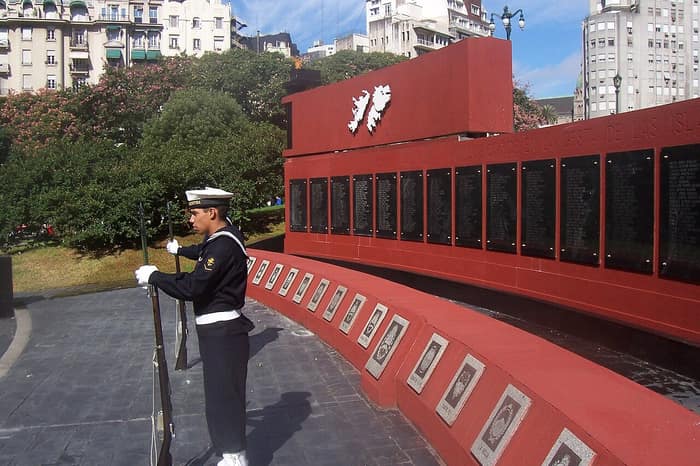
Monumento a los caídos en Malvinas
Retiro, Buenos Aires · a cenotaph with the 649 names of the fallen
200 m away

Paz Palace
Retiro, Buenos Aires · a French château with 140 rooms
300 m away
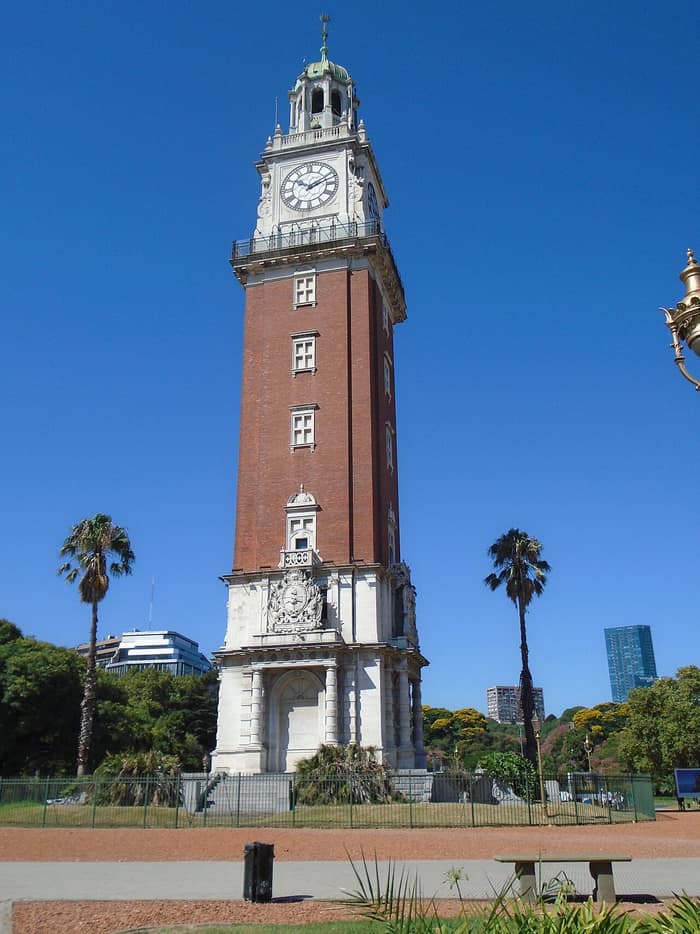
Torre Monumental
Retiro, Buenos Aires · the clock tower given by the British community
300 m away

San Martín Palace
Retiro, Buenos Aires · the Beaux-Arts palace of the Foreign Ministry
400 m away