
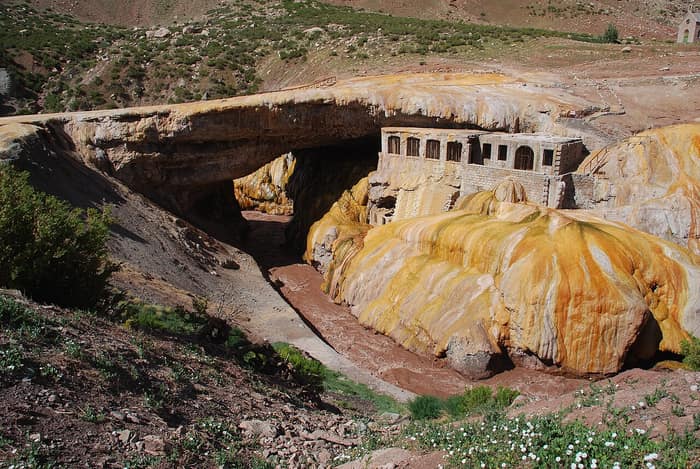
Puente del Inca, the colourful natural arch of the Andes
Puente del Inca (Bridge of the Inca) is a natural arch spanning the Cuevas River in the Andes, in Las Heras Department, Mendoza Province. It lies at about 2,700 metres, 183 km from the city of Mendoza along National Route 7, and its green, orange and ochre tones make it one of the most striking hidden gems of Mendoza.
A legend says Inca warriors linked arms to form a human bridge and turned to stone when looked at. Science tells another story: a travertine arch shaped over thousands of years by hot springs and a river.
The history of Puente del Inca
The Puente del Inca natural monument rises in the Andes at about 2,700 metres, between the hills Banderita Norte and Banderita Sur, in the Las Cuevas district of Las Heras Department. It lies 183 km from the city of Mendoza along National Route 7, near the pass to Chile and the main entrance of Aconcagua Provincial Park. The arch hangs 19.2 metres above the river and measures 53.4 metres long, 27.6 wide and 10.2 thick.
Its structure is made mostly of travertine and cemented debris, the result of the mineral-rich thermal waters that flow over it. The most recent theory proposes that large flows of material from megalandslides on the south face of Aconcagua were deposited in the Cuevas valley and formed dams that helped the hot-spring waters cement them. The process would have begun about 14,000 years ago and the arch opened between 8,600 and 8,300 years ago, through erosion by the river. Four main thermal springs can be told apart today, and the green, orange, yellow and ochre of the surface is partly due to microbial communities.
The place has been known since pre-Columbian times and lay on the Inca road network, now part of the Qhapaq Ñan system, a UNESCO World Heritage Site. Hence its name. A Quechua legend tells that the heir to the empire suffered a strange paralysis and was sent from Cuzco to these springs to be cured; so that he could cross, warriors linked arms to form a human bridge, and when he looked back to thank them he saw them turned to stone. In March 1835 Charles Darwin visited the site and drew the bridge with its large stalactites.
In the early 20th century the hot springs were developed as a spa resort: a luxury hotel, a church, a set of baths attached to the natural structure and a tunnel linking the hotel to the baths were built. Visitors arrived by train at a station of the Transandine Railway, one of the last Argentine stops before the line continued into Chile through a long tunnel under the Andes. In 1965 an avalanche badly damaged the hotel and the place was finally abandoned.
For years access to the bridge and the baths, which were not damaged, was unrestricted. In 1991 the monument was declared an untouchable zone, and in 2005 a provincial law created the protected area with the status of natural monument. Thousands of tourists visit every year and it can only be viewed from the north-eastern bank of the Cuevas River. The old railway station houses the Museo del Andinista, created by a group of mountaineers from Rosario.
Curious facts about Puente del Inca
- Charles Darwin visited Puente del Inca in March 1835 and made drawings of the bridge with its large stalactites.
- According to a Quechua legend, Inca warriors formed a human bridge so that the heir could reach the hot springs, and were turned to stone.
- Stalactites hang from the underside of the bridge and, in winter, so do needles of ice.
- The green, orange, yellow and ochre colours of the bridge are partly due to microbial communities and the minerals deposited by the hot-spring water.
- The hot-spring water is so rich in minerals that it has been known to petrify small objects in a mineral layer.
- The old Transandine Railway station is now the Museo del Andinista, founded by a group of mountaineers from Rosario.
Tours near Puente del Inca
Experiences in the area that you can book online with Viator:


Visiting Puente del Inca
- It is reached by National Route 7, 183 km from the city of Mendoza, near the pass to Chile.
- Since 1991 the site has been an untouchable zone: the bridge can only be viewed from the north-eastern bank of the Cuevas River and cannot be walked on.
- It lies between the two trailheads for climbing Aconcagua, the highest mountain in the Americas. Los Penitentes is also nearby, about 7 km away.
- The Museo del Andinista, in the old station, is open to the public in summer; check the current days and hours.
- At over 2,700 metres winters are snowy and summers dry and mild, so dress warmly and check road conditions.
Opening hours, access and conditions can change. Check before you go.
Map: where Puente del Inca is
Photos of Puente del Inca


Questions
What is Puente del Inca in Mendoza?
It is a natural travertine arch over the Cuevas River in the Andes, protected as a natural monument. The hot-spring waters that bathe it tint it green, orange, yellow and ochre.
Where is Puente del Inca?
In Las Heras Department, Mendoza Province, 183 km from the city of Mendoza along National Route 7 and near the pass to Chile.
How was Puente del Inca formed?
According to the most recent theory, material from large Aconcagua landslides was cemented by hot-spring water, and the Cuevas River opened the arch by erosion between 8,600 and 8,300 years ago.
Why is it called Puente del Inca?
After the natural structure and old tales linked to the spot, which lay on the Inca road network. A Quechua legend speaks of a bridge of Inca warriors.
Can you walk on Puente del Inca?
No. Since 1991 it has been an untouchable zone, and the bridge can only be viewed from the north-eastern bank of the Cuevas River.
What else is there to see near Puente del Inca?
The Museo del Andinista in the old Transandine station, the remains of the former spa and, about 7 km away, Los Penitentes. The entrance to Aconcagua Provincial Park is also close.
Also nearby

Los Penitentes
Mendoza · a 1979 ski resort on Route 7, near Aconcagua
7 km away

Hotel Villavicencio
Las Heras, Mendoza · a grand mountain hotel closed in 1979
90 km away

Our Lady of Loreto Cathedral
Mendoza · the church that has been a cathedral since 1934
100 km away

Félix Aguilar Observatory
San Juan · Andean telescopes watching the southern sky
126 km away