
Salta Cathedral, shrine of the Lord and Virgin of the Miracle
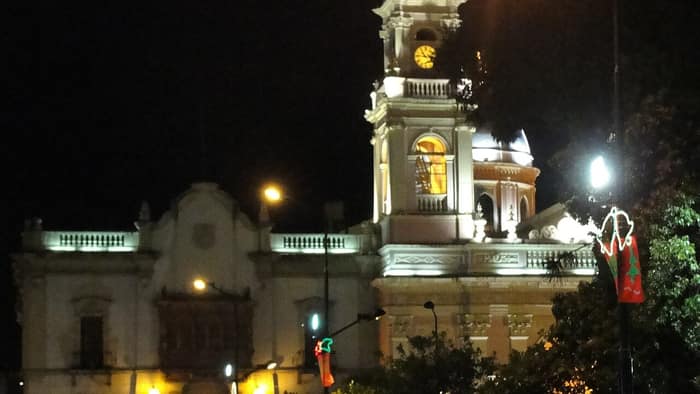
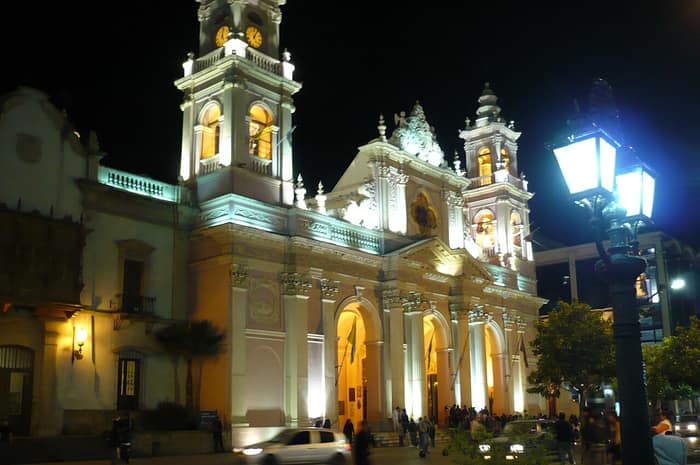
Salta Cathedral is the basilica cathedral and shrine of the Lord and the Virgin of the Miracle, facing Plaza 9 de Julio in the heart of the city's historic centre. Richly decorated and a pantheon of independence heroes, it is one of the top stops among the hidden gems of northern Argentina.
Its façade and towers were still unfinished when the church was blessed in 1878, and who designed them was debated for decades, until a rediscovered document supplied a name.
The history of Salta Cathedral
The present cathedral replaced an earlier church damaged by an earthquake. The sources disagree on the year of the quake, giving 1844 or 1856. What is clear is that in 1856 the project was commissioned from the French-American engineer Felipe Bertrés and fund-raising began, but Bertrés died in Salta that same year and could not start the work.
Building began in 1858 at the urging of Bishop José Eusebio Colombres. For about twenty years the new church rose, with the participation of Italian and Brazilian artists. After a long period when the works were stalled, they resumed in 1873 with the firm of the architects Nicolás and Agustín Cánepa. Once disputes between the Church and the builders were settled, such as leaks in the dome and changes to the interior design (a raised choir at the entrance was chosen), the church was blessed in 1878, with the pediment, towers and atrium still unfinished.
That part was left for later. A document rediscovered by the National Academy of Fine Arts attributes the design of the façade and towers to the architect Noé Macchi, and records that in 1879 the work on the pediment was contracted to the builder Riguetti following his plan. Until then, various studies had proposed other names. The whole complex was completed in 1882, bells included.
Inside, the high altar was designed by Fray Luis Giorgi, an Italian friar who came to Salta as a missionary in 1856 and worked there as a sculptor and architect; he also made the side altars of the miraculous images and the mausoleum of Güemes. Those images are a crucified Christ and a Virgin that, according to tradition, protected the city from the earthquake of 1692, and they are the origin of the great feast of the Miracle.
In 1899 Pope Leo XIII granted the decree of pontifical coronation for both images, and Bishop Matías Linares y Sanzetenea performed the public rite of coronation on 13 September 1902. The shrine was opened to the public on 20 October 1918 and on 14 June 1941 the church was declared a National Historic Monument. Over the years the cathedral also took on the role of pantheon of the heroes of the Army of the North.
Curious facts about Salta Cathedral
- Who designed the present façade and towers was debated for decades, until a document rediscovered by the National Academy of Fine Arts attributed them to the architect Noé Macchi.
- The architect of the original project, Felipe Bertrés, died in Salta in 1856, the very year he was commissioned.
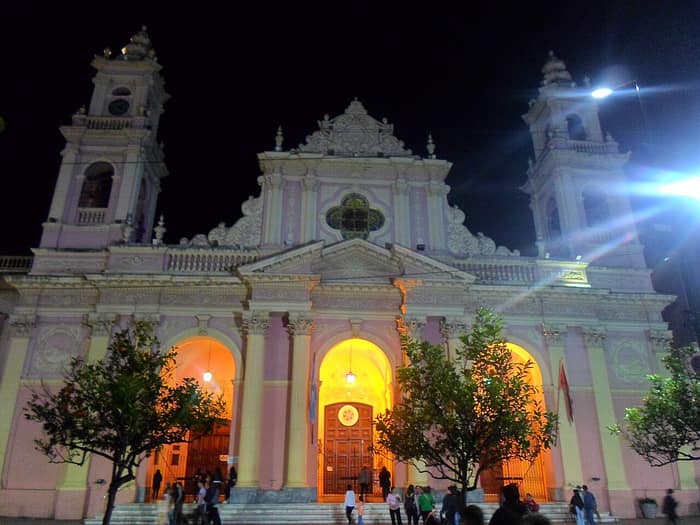
- The atrium has ten Corinthian columns, and between the towers, above the pediment, there is a quatrefoil stained-glass window.
- The remains of General Martín Miguel de Güemes, a gaucho hero of independence, rest in the cathedral alongside those of other figures such as General Antonio Álvarez de Arenales and Martina Silva de Gurruchaga.
- According to the sources, the feast of the Miracle gathers more than 800,000 people every year; the celebrations begin with a novena on 6 September and culminate in the processions of the 15th.
- The neighbouring Archbishop's Palace, of Neo-Baroque character, was modified in the 1930s to acquire its present American Baroque look.
Tours near Salta Cathedral
Experiences in the area that you can book online with Viator:


Visiting Salta Cathedral
- The cathedral faces Plaza 9 de Julio, next to the Archbishop's Palace, and is an easy walk from the city centre.
- Look at the façade with its atrium of Corinthian columns and, inside, the three naves, the lantern-topped dome, the stained glass and the high altar.
- Inside are the pantheon of the heroes of the North, with the remains of Güemes, and the altars of the Lord and the Virgin of the Miracle.
- Behind the cathedral, on Calle Belgrano, is the Museo Catedralicio Monseñor Carlos M. Pérez, with paintings, carvings and silverwork of the 18th and 19th centuries; check the current opening days and hours.
- As a shrine, it draws very large crowds of pilgrims in the week of the feast of the Miracle in September.
Opening hours, access and conditions can change. Check before you go.
Map: where Salta Cathedral is
Photos of Salta Cathedral


Questions
What is Salta Cathedral?
It is the basilica cathedral and shrine of the Lord and the Virgin of the Miracle, seat of the Archbishop of Salta. It was built in the second half of the 19th century and declared a national historic monument in 1941.
Where is Salta Cathedral?
In the historic centre of the city of Salta, facing Plaza 9 de Julio and next to the Archbishop's Palace.
Who is buried in Salta Cathedral?
General Martín Miguel de Güemes rests there, along with other figures of the independence era such as Antonio Álvarez de Arenales, Rudecindo Alvarado and Martina Silva de Gurruchaga.
What is the Lord and Virgin of the Miracle?
Two images venerated in the cathedral, a crucified Christ and a Virgin, which tradition says protected the city in the 1692 earthquake. Their annual feast is held in September.
When was Salta Cathedral built?
Building began in 1858 and the church was blessed in 1878. The whole complex, with its façade and towers, was completed in 1882.
Is there a museum at Salta Cathedral?
Yes, the Museo Catedralicio Monseñor Carlos M. Pérez, behind the cathedral on Calle Belgrano. Check the days and hours before you go.
Also nearby

America Cultural Center
Salta · from social club to Government House and cultural centre
150 m away

Tastil
Salta · the largest pre-Columbian city in present-day Argentina
67 km away

Jujuy Cathedral
San Salvador de Jujuy · colonial church with an Indigenous-carved pulpit
68 km away
Yatasto Relay
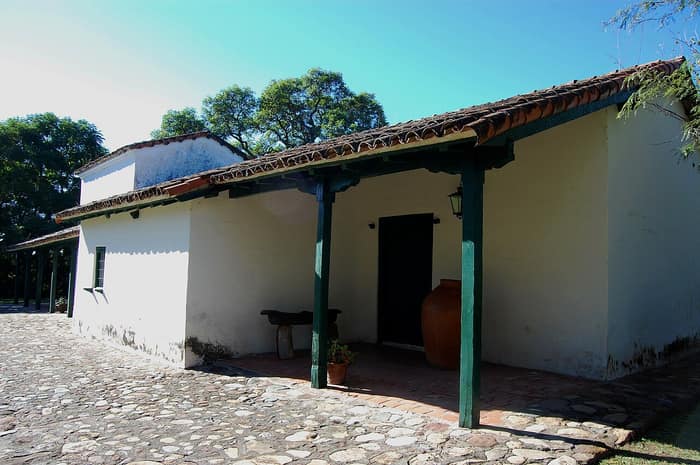
Near Metán, Salta · a colonial post stop of the Independence war
100 km away